Why the Same Skin Costs Different Amounts on Different Sites
05 August 2026
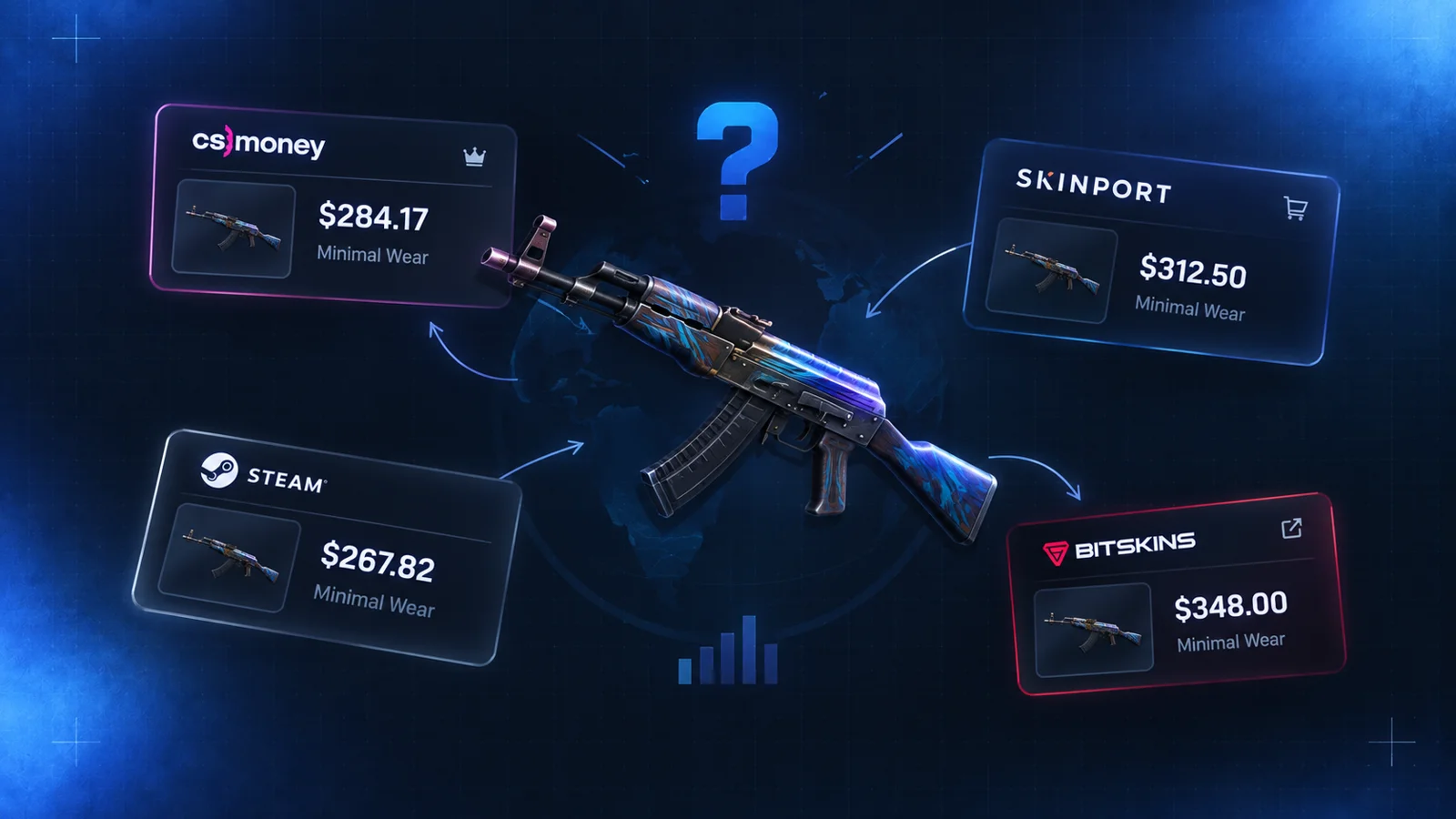
You check a skin in one place and it's $40. You check somewhere else and it's $31. Same weapon, same condition, no obvious catch. This is normal, and once you know the reasons it becomes easy to tell a good price from a bad one.
1. Steam money is not cash
This is the biggest single reason, and it explains most of the gap.
Money in your Steam wallet can only be spent on Steam. You can't withdraw it. A sale on the Steam Community Market also carries roughly 15% in fees, which comes out of the seller's side. So a seller who wants actual money has to sell somewhere else, usually for less - and buyers who only have Steam wallet funds are willing to pay more, because that balance has no other use.
The result is that Steam prices sit above cash prices for the same item, sometimes by 20–30%. Neither number is "wrong". They're prices in two different currencies.
Because of that, be careful when a site advertises a discount "compared to Steam prices". The comparison is against an inflated reference.
2. Instant sell and listing are two different prices
Almost every trading site offers both:
Instant sell. You hand the skin over and get paid right away. The site takes the inventory risk and the holding cost, so it pays below market. This is the lower number.
Listing it yourself. You set a price and wait for a buyer. You get more, but you might wait days, and you might have to cut the price.
When people compare sites and find wildly different numbers, they are often comparing an instant-sell quote in one place with a user listing in another. Compare like with like.
3. Fees, and where they're hidden
Fees show up in different places depending on the site. Some take a cut from the seller, some add it to the buyer's total at checkout, some bury it in the exchange rate or the withdrawal method. A site with a headline 0% fee usually earns on the spread instead - the difference between what it buys at and what it sells at.
The only number that matters is the one you actually receive, or actually pay, at the end. Check the final total before you compare anything.
4. It isn't quite the same skin
Two listings can share a name and a condition and still be different items:
Different float values within the same condition tier.
Different pattern indexes, which is the whole ballgame on Case Hardened, Doppler, Fade and Marble Fade skins.
StatTrak or souvenir versions.
Stickers applied, which can add value or, on a plain skin someone wanted clean, subtract it.
Before you conclude a listing is cheap, confirm you're comparing the same item and not just the same title.
5. Supply and how many people are trading there
A busy marketplace with fifty of the same skin listed will drive prices toward the bottom of the range, because sellers undercut each other. A quiet one with two listings can hold a much higher price simply because nothing forces it down.
The same effect works in reverse for rare items. Thin markets are where you find both the best deals and the worst ones.
6. Trade locks and delivery
An item that is trade-locked for a week is worth less than an identical one you can move today, because the buyer carries the risk that the price falls while they wait. Sites that specialise in locked items usually price them 5–10% lower. That's not a bargain - you're being paid to wait.
Delivery speed matters too. Instant delivery from a bot inventory costs more than a listing where you wait for a person to accept your trade offer.
7. Payment methods and region
Card fees, crypto fees and payout fees all differ, and they get built into prices. Currency conversion adds another few percent that most people never notice. If a site prices in one currency and charges you in another, the number you see is not the number that leaves your account.
8. Price indexes lag
Many sites display prices based on recent sales data. During a big move - after an update, a new case, or a market panic - that data is hours or days behind reality. Two sites can genuinely believe different things about what a skin is worth right now.
How to compare properly
Pick the exact item, including float and pattern.
Get the final price: what you pay including fees, or what lands in your account after them.
Note whether it's instant or a listing, locked or tradable now.
Only then compare across sites.
A gap that survives all four checks is a real difference. Most gaps don't survive step two.
When cheap is too cheap
A price far below every other site is worth a second look, not a fast click. The usual explanations are a trade lock you didn't notice, a bad float, a fake site imitating a real one, or an item that was obtained in a way that will get it clawed back. Legitimate sites don't sell 40% under market for no reason. Nobody does.